Start With the Season You Plan to Use It
If you want a shower for summer weekends, a seasonal setup that you drain in the fall is the sensible choice. A year-round outdoor shower in Burbank needs heated enclosures or insulated runs, which is a much larger project.
Decide the season first. It sets the equipment, the cost and the maintenance.
Three Ways to Heat an Outdoor Shower
The choices differ in cost, convenience and winter risk.
| Option | How it works | Winter plan |
|---|---|---|
| Portable propane tankless unit | A small unit on a propane cylinder with a hose connection | Disconnect and store indoors |
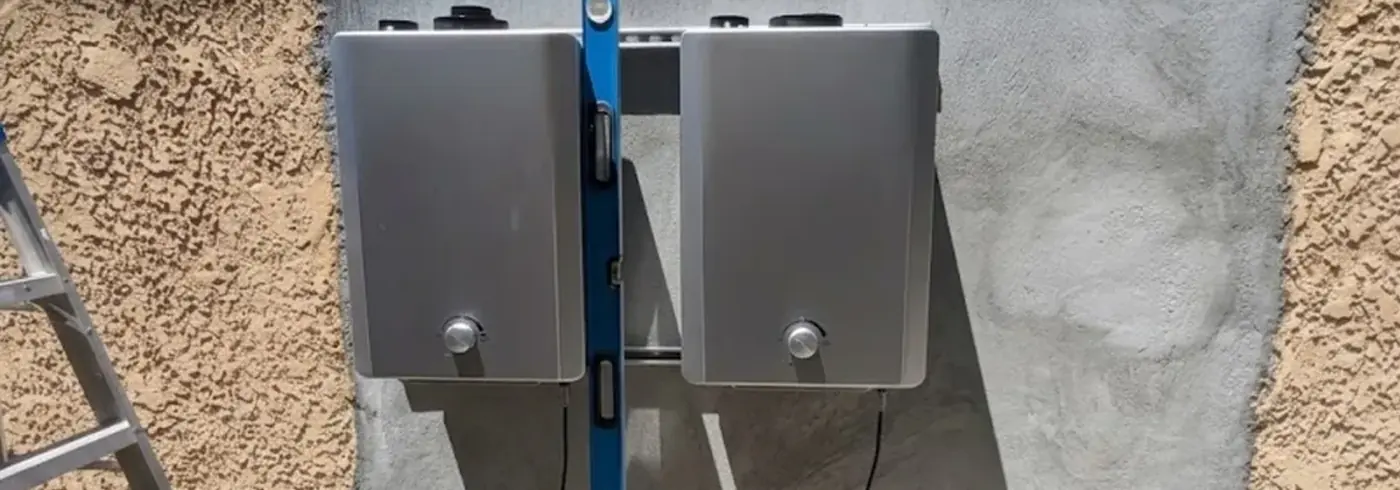
| Outdoor-rated tankless unit on a wall | A weatherproof unit tied to the house gas or propane | Drain and winterize or isolate |
| Indoor tankless with a line to a shower | The shower is fed from the house heater | Drain the outdoor leg and shut it at an indoor valve |
Which option fits depends on how permanent the shower should be.
Planning an outdoor shower?
Call dispatch to talk through the setup.
Details That Decide Whether It Works
Outdoor installations have extra rules.
Unit rating
Use a unit marked for outdoor use or place it in a protected enclosure. Indoor units exposed to rain fail quickly.
Gas and ventilation
Gas units need correct venting and clearances. Never run a gas appliance in an enclosed space without proper venting, since carbon monoxide is a real risk.
Water supply
A hose bib with a backflow preventer is the simplest source. Plan an indoor shutoff for winter.
Drainage
Shower water must drain away from the house foundation. Check local rules on where greywater may go.
Why Freeze Protection Is Not Optional in Burbank
The South Stickney Sanitary District, which delivers water in Burbank, notes that frozen service lines can be shut off at the curb box near the street that it calls the Buffalo Box. The advice reflects how often cold weather freezes water lines in this area.
An outdoor shower line is far more exposed than a buried service line. A single hard freeze can burst a supply line, so drain it fully and close its indoor valve each fall.
Source: South Stickney Sanitary District customer FAQ.
Fall Shutdown Routine
Follow a routine every season.
Shut the supply
Close the indoor valve that feeds the outdoor line.
Drain everything
Open the shower valve and a drain at the low point to empty the pipes.
Drain the heater
Follow the manufacturer's steps to empty the heat exchanger.
Store the portable parts
Disconnect hoses and bring small units indoors.
Permits and Code
The City of Burbank Building Department requires a permit for construction or alteration of plumbing and for work involving gas piping. The office is at 6530 W 79th Street, phone 708-599-5500, option 2.
A licensed plumber can tell you whether a portable setup, a permanent wall unit or a line from the house needs approval.
Alternatives Worth Considering
If your goal is rinsing off after the pool or the garden, a cold hose with a mixing valve or a solar bag may be enough. A mudroom or basement shower with an indoor heater avoids freezing.
Our tankless water heater service can advise on which approach suits your yard.
Planning Checklist Before You Build
A few decisions save money and rework.
- Choose the season you will use it and the unit type that fits
- Pick a spot near a hose bib or a supply line and away from the foundation drain
- Plan where the water will go and whether it will run toward a neighbor
- Decide how you will shut it off and drain it in the fall
- Check local rules on gas piping and permits before buying equipment
A short plan on paper prevents a shower that you cannot use in October.
Privacy, Drainage and the Yard
An outdoor shower needs a surface that drains, such as gravel or a slatted platform, so that the ground does not turn to mud. Keep the platform away from the house foundation, because standing water near a basement wall can lead to seepage.
Soap and shampoo go to the ground. Use mild, biodegradable products, and avoid draining toward a garden bed or a storm inlet.
Winter Care for an Outdoor Setup
Illinois winters will crack any pipe that holds water in freezing weather. Before the first hard freeze, shut off the supply, open the valves and drain the lines and the heater according to the manufacturer instructions.
Disconnect and store any hoses, and cover or bring in the unit if it is not rated for outdoor use. A few minutes of work in the fall avoids a burst pipe in January.
Power, Gas and Venting Outdoors
A tankless heater needs a reliable fuel supply and, for gas models, correct venting. An outdoor rated unit is built to vent in the open air, while an indoor unit placed outside is not safe.
Check the clearances in the manual, and have a licensed plumber run gas piping. A small leak in a gas fitting is a hazard you cannot see, so pressure testing matters.
Nearby Homes and Yards
Yards in Oak Lawn and Bridgeview have the same winter exposure, so the same freeze plan applies.
If a line burst last season, see burst pipe repair for what to do.
Standards for Outdoor Installations
Gas piping follows NFPA 54, and outdoor use depends on the unit being rated for it by the manufacturer. Water supply lines must meet the Illinois Plumbing Code, the state standard found in 77 Ill. Adm. Code 890 and administered by the Illinois Department of Public Health.
Ask the City of Burbank Building Department whether a permit is needed before you build.
Outdoor Shower Questions in Burbank
Only if it is outdoor-rated and properly drained or protected. Water left in the unit freezes and can crack the heat exchanger.
Natural gas needs a line from the house, and propane needs a cylinder. The choice depends on the site and the unit.
A backflow preventer on the hose connection protects the house supply. A plumber will specify the right device.
Yes, but it needs a drainable outdoor leg and an indoor shutoff for winter.
It should flow away from the foundation. Check local rules before running it to a drain or a garden.
Questions about an outdoor shower? Call dispatch.